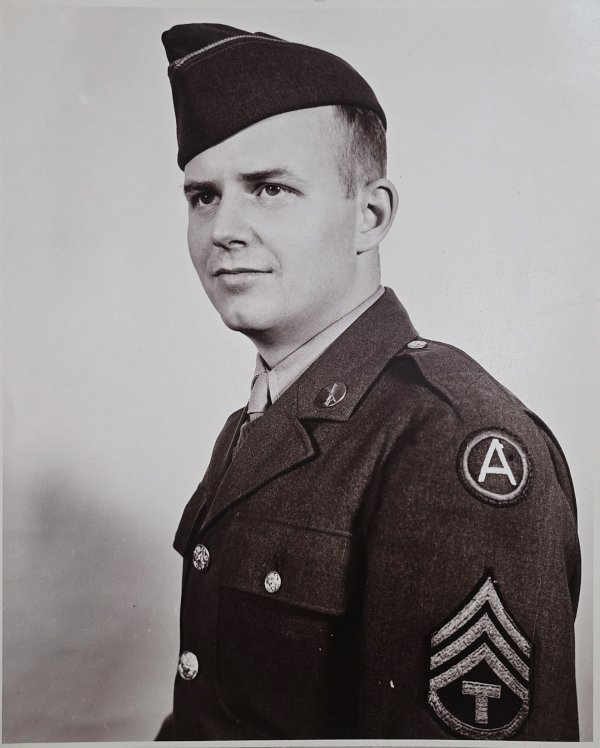
Omaha, Nebraska · Headquarters, Third United States Army
June 19, 1916 – July 6, 1999
Technical Sergeant Norbert E. Nelson spent the last two years of World War II inside the nerve center of General George S. Patton's Third Army — keeping its secret journal, its operations maps, and its files, and carrying its orders forward from Normandy to Bastogne to the Danube. This is his record, told through his own letters home and the official documents that survive alongside them.
Beginnings
Norbert Edward Nelson was born June 19, 1916, in Omaha, Nebraska, the son of Jonas J. Nelson and Effie Esther Nelson. He grew up alongside siblings Howard, Robert, Glenna, Gerald, and Walter, in a family that, like most in Omaha at the time, weathered the Depression and watched the world edge toward war.
Before the war, Norbert worked as a stenographer and investments clerk for the Woodmen of the World Life Insurance Society, starting in September 1934. It was steady, exacting office work — the kind that trains a fast, accurate hand at a typewriter. That skill, more than anything, would decide where the Army sent him: not to a rifle company, but to a desk at the heart of one of the largest field armies in American history.
He returned to that same job at Woodmen of the World after the war, in November 1945, the ordinary homecoming of a man who had spent the two years between typing something considerably more consequential than insurance correspondence.
1942 – 1945
Norbert's path to Patton's headquarters ran through a hospital unit, a washed-out officer course, and a promotion earned at a manor house in England — not the more familiar route of a combat replacement.
Assigned to the Infantry-Medical branch and sent to Camp Barkeley, Texas, for training with the Medical Replacement Training Center.
Completed the Medical Replacement Training Center's Clerks School — military correspondence, personnel records, company administration, supply, and sick & wounded reporting — typing 80 words per minute. This certificate, and the office skills behind it, is the real reason his war looked the way it did.
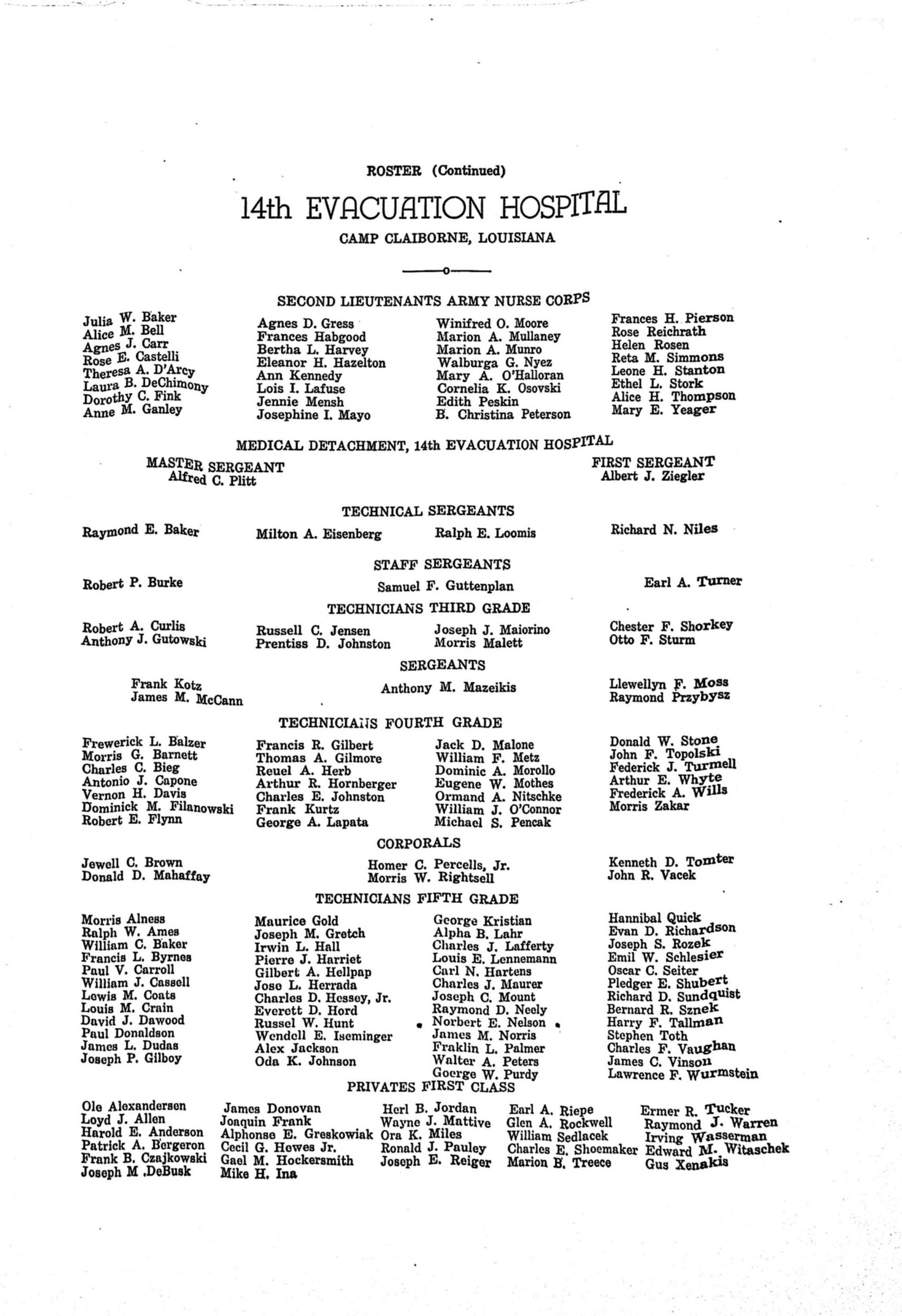
The unit's 1942 Christmas roster lists him among the Technicians Fifth Grade. This was his first documented posting, well before Third Army existed as an operational headquarters.
Briefly sent to officer candidate school at Camp Davis, North Carolina, but relieved due to a dislocated knee cartilage and returned to Headquarters, Special Troops, Third Army.
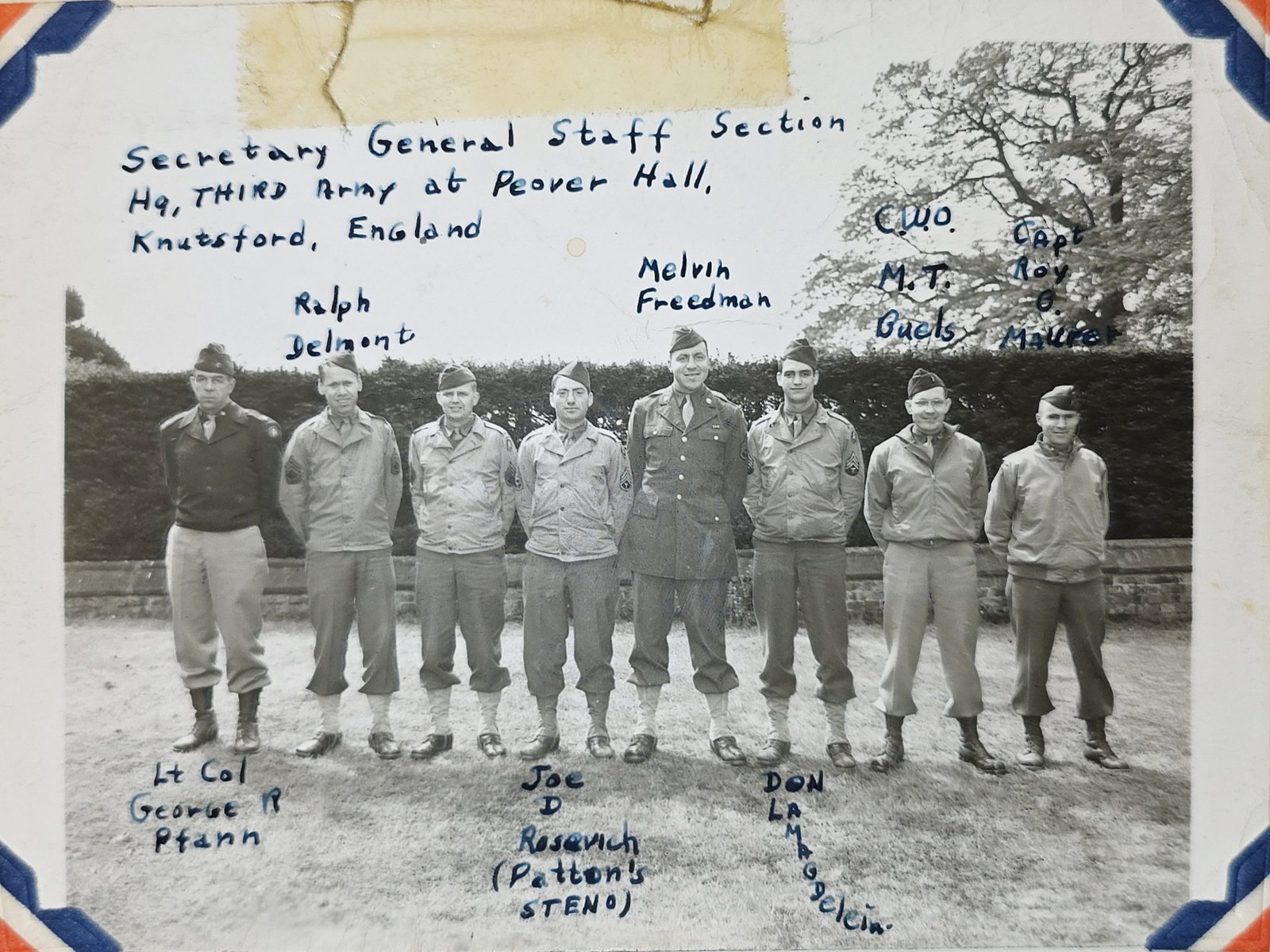
By the spring of 1944, Norbert was working inside Third Army's Secretary, General Staff (SGS) Section at Peover Hall, the manor house serving as Third Army's planning headquarters ahead of the invasion — part of the small circle preparing the operational plans for the breakout across France, under strict secrecy in the weeks before D-Day.
1944 – 1945
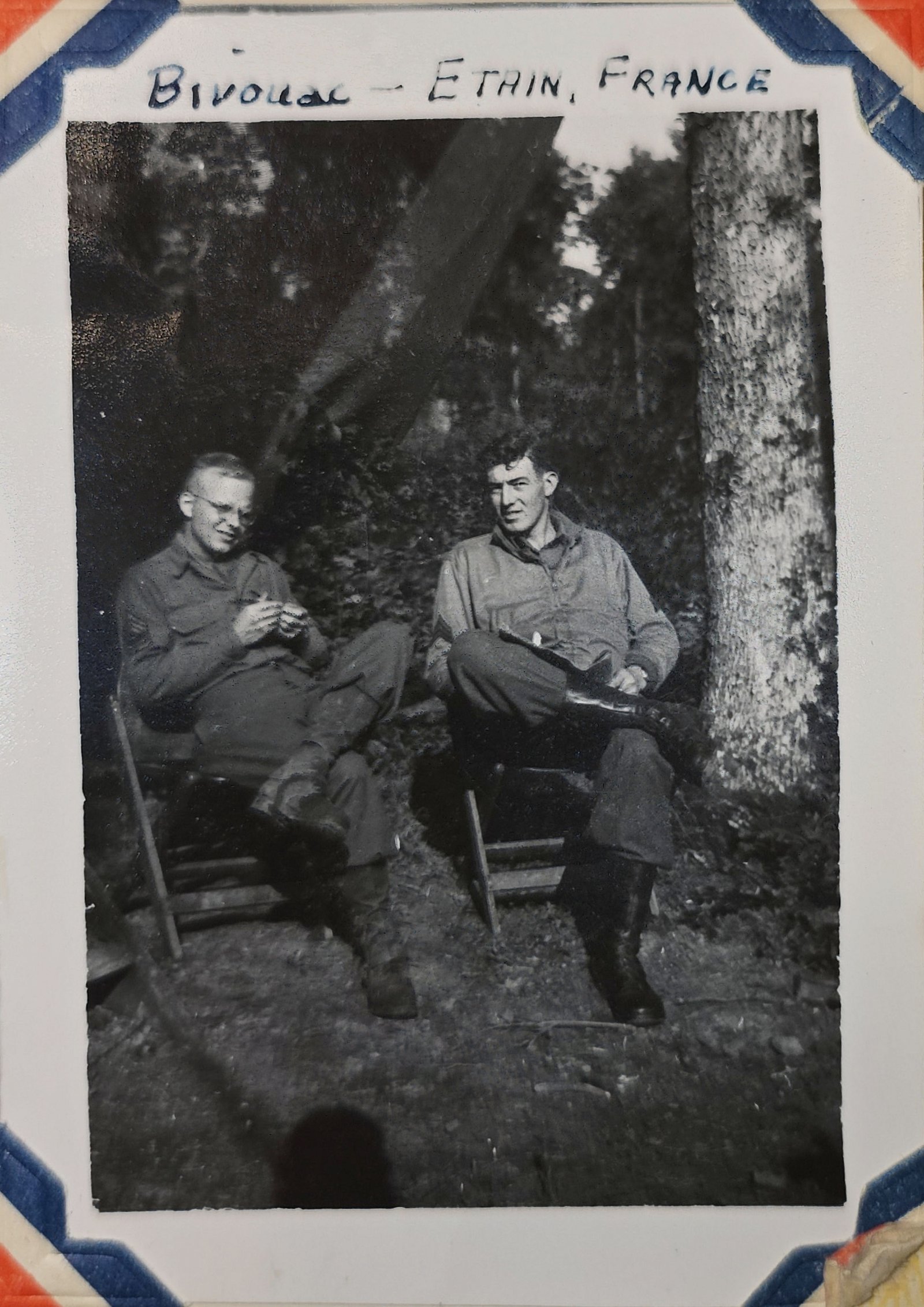
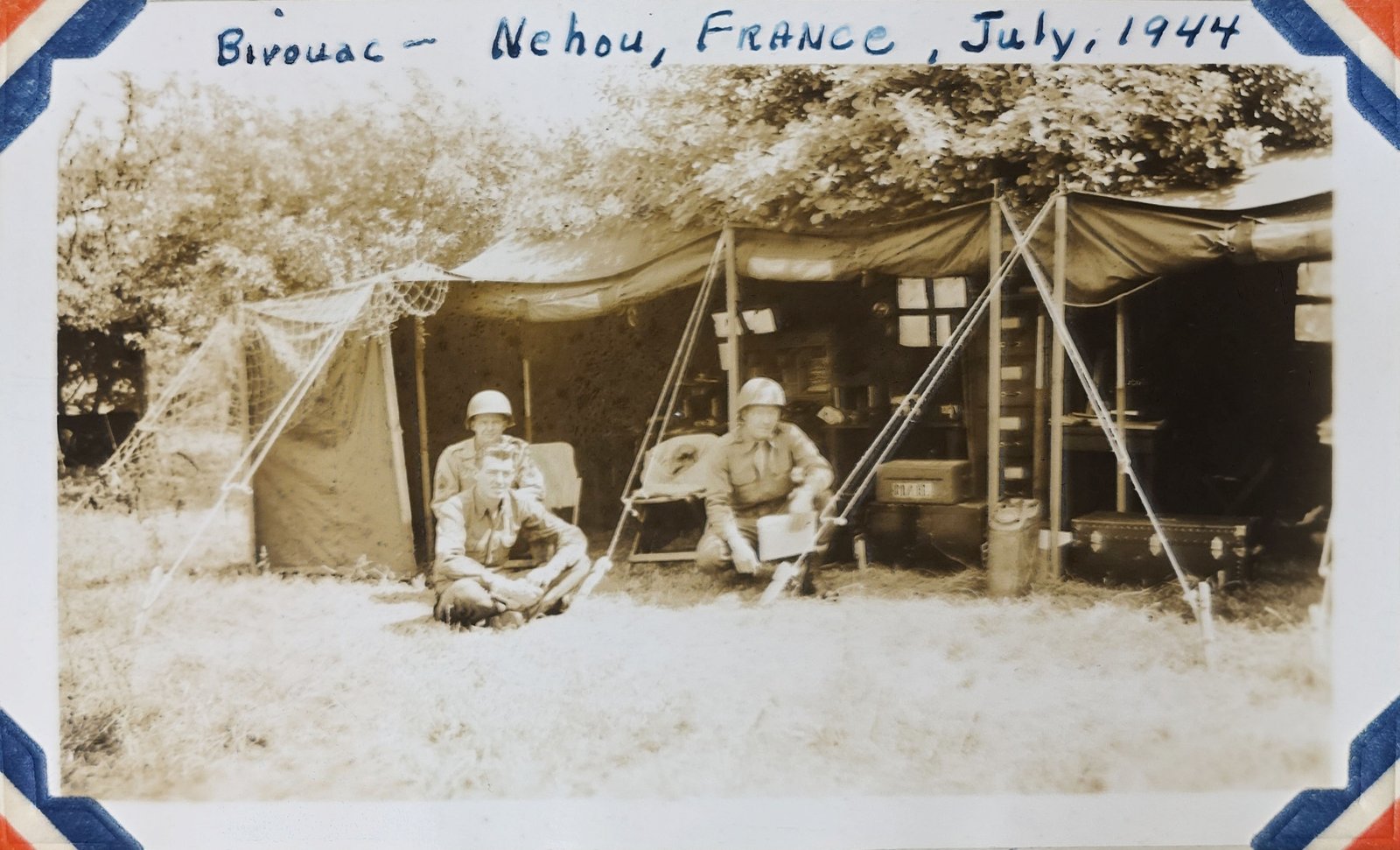
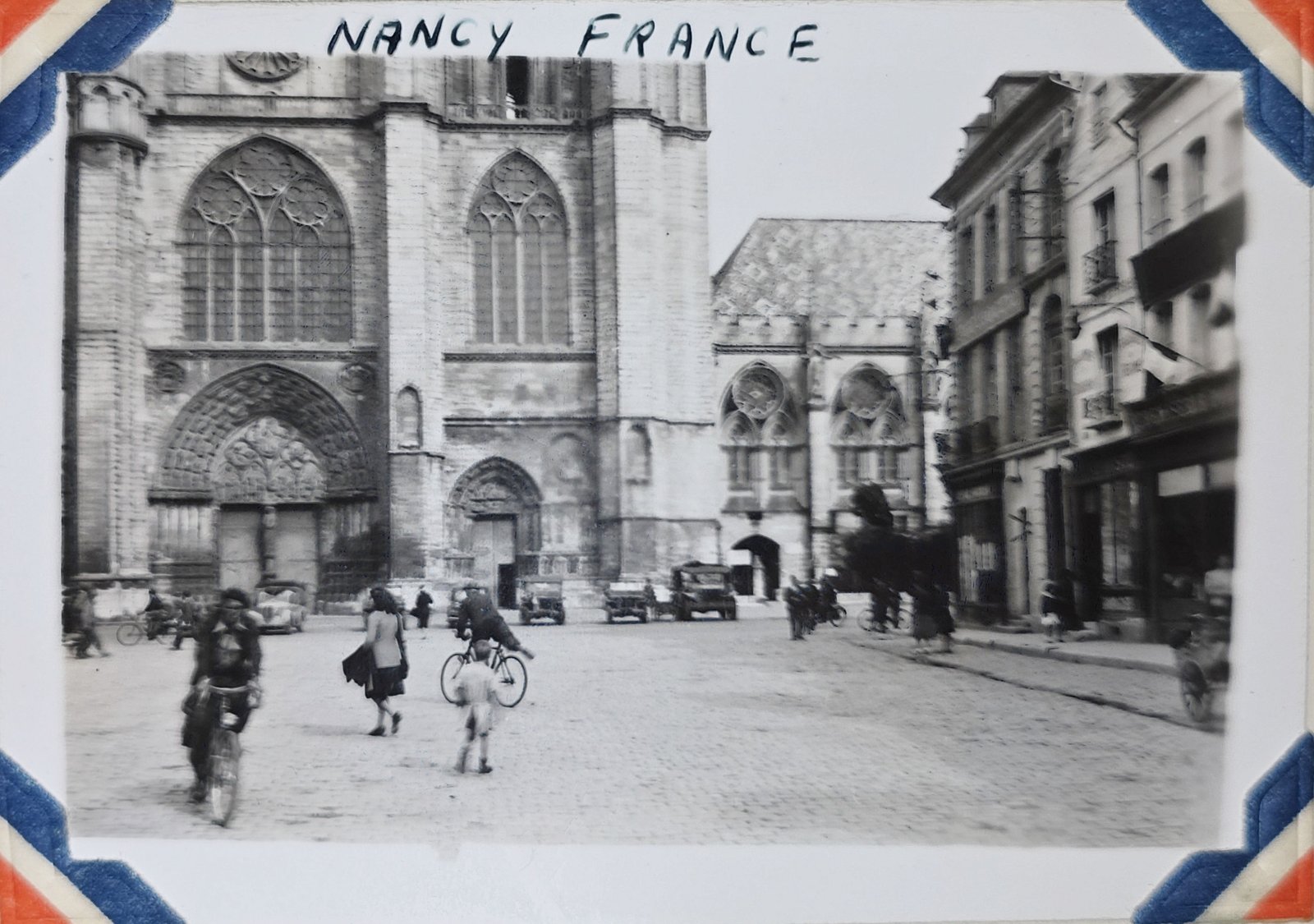
Norbert crossed to France on Utah Beach, July 6, 1944 — D-plus-30 — landing from an LST after the crossing from England. His own account of that summer and fall, written in a long retrospective letter home the following spring, traces a campaign trail most infantrymen never got to describe in one unbroken sweep, because his job was to keep moving with Army Headquarters itself: Nehou, Muneville-le-Bingard, Beauchamps, St. James, Fougeres, Laval, Le Mans, Pithiviers, Chalons, Etain, and, in October 1944, Nancy.
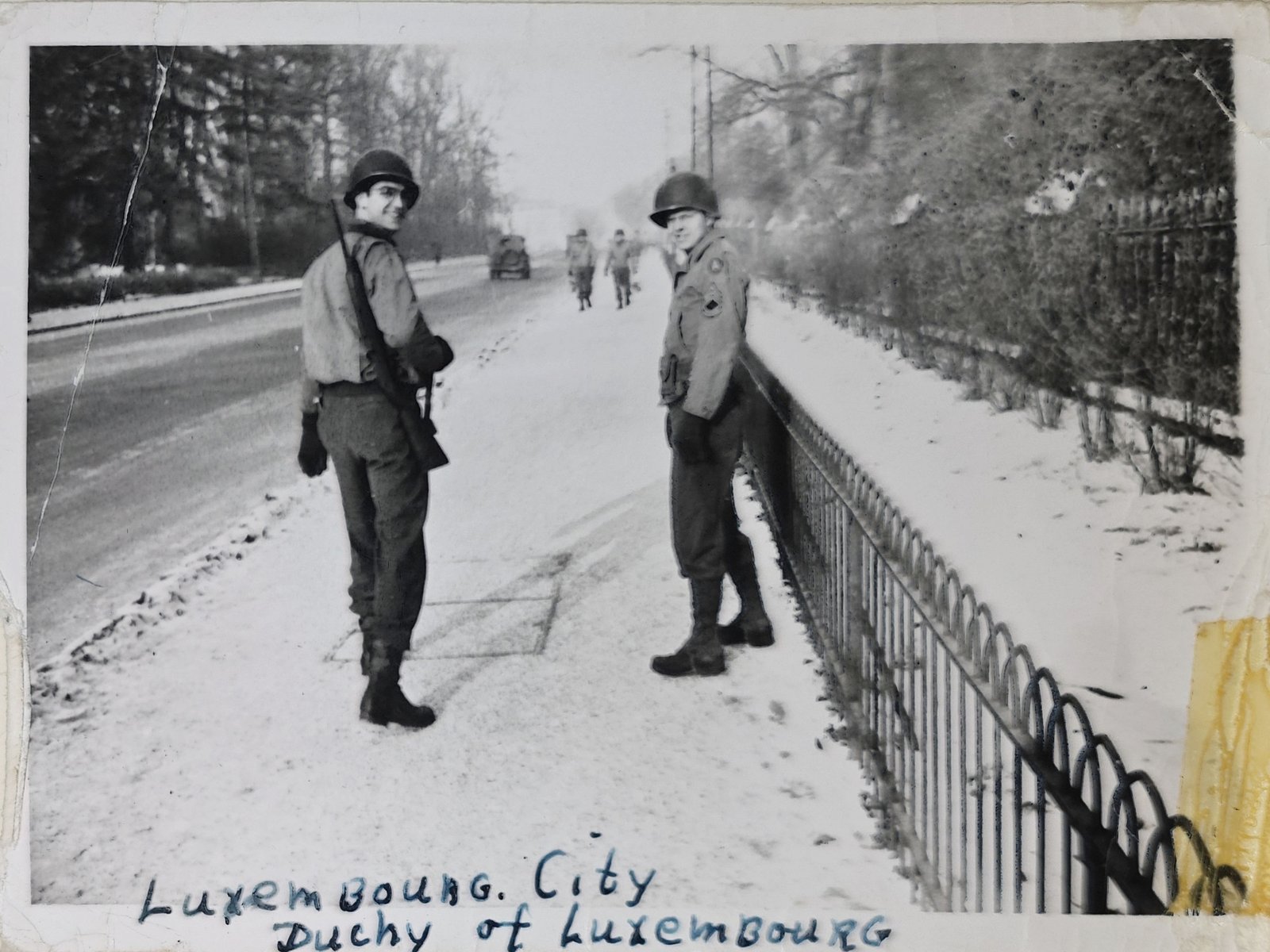
On December 19, 1944 — two days after the German counteroffensive broke through in the Ardennes — Norbert was ordered onto an advance party racing north to Luxembourg City. As steno to the Deputy Chief of Staff, he was among the first from Third Army Headquarters into the Duchy, working through the night while the air raid sirens sounded, ahead of Patton's famous 90-degree pivot of the entire Army to relieve Bastogne.
His formal duties, per his own Separation Qualification Record, were administrative assistant to the Deputy Chief of Staff of Third Army: he established and maintained the general staff section's file system, kept a top-secret journal, worked as stenographer, and kept the operations maps current against incoming field reports — the paperwork, in other words, that a field army's command post runs on.
Awarded to Technical Sergeant Norbert E. Nelson for meritorious service in France, Luxembourg, and Germany, September 15, 1944 to April 1, 1945, in the Chief of Staff Section. Signed by Hobart R. Gay, Major General, Chief of Staff.
Addressed directly to “T/Sgt Norbert E. Nelson” at the top, a letter from General Patton to the officers and men of the General and Special Staff praised their work behind what he called the “almost incredible results” of the operation then underway — the relief of Bastogne.
Family Story, Documented Role, Historical Record
After Norbert's death in 1999, a KMTV news segment quoted his widow, Ruth Nelson, saying he had written speeches for General Patton, including material connected to the Battle of the Bulge — and specifically noting it was “not the exact wording as was used in the movie.” That claim deserves to be told honestly, which means telling it in three separate, clearly labeled parts rather than folding them into one story.
On Veterans Day 1999, KMTV (CBS affiliate, Omaha) aired a segment about the conservation of Norbert's wartime papers, including a letter connected to a Patton speech. Ruth Nelson stated in that broadcast that Norbert wrote speeches for Patton, including Battle of the Bulge material, distinct from the film version.
This is family testimony, sourced and dated to that broadcast. It is presented here as what was said, not independently verified as literal authorship of any specific speech.
Norbert's own letters describe direct, close proximity to Patton's staff work during the Bulge. Writing home in March 1945, he referred to “the prayer that the big boss wrote” clearing the skies over the Ardennes — almost certainly Patton's famous December 1944 weather prayer, composed by Chaplain James H. O'Neill at Patton's direction and distributed to the whole Third Army on December 22, 1944, an episode first told publicly by Col. Paul D. Harkins, Norbert's own section chief.
An undated letter fragment goes further: “I was fortunate in taking part in many major and highly secret plans, and his military brilliance was outstandingly the reason for Third Army's victories.” That is Norbert's own description of his access — not a claim of speechwriting specifically, but real proximity to Patton's planning process at the SGS level.
The speech most people know from the 1970 film Patton, opening with “Americans love a winner and will not tolerate a loser,” was not a single scripted address. Historians have reconstructed it from the memories of soldiers who heard Patton deliver versions of it to Third Army units in late May and early June 1944, before the invasion of France — no official transcript survives, and Patton spoke from memory each time, varying the wording. The film's version is a toned-down composite built for the screen, not a verbatim recording of one speech on one date.
Norbert's own record is consistent with this: he was assigned to Third Army Headquarters from mid-1944 on, present for the planning and paperwork around Patton's major campaigns, including the Bulge, without a surviving document that names him as the author of a specific address.
Cast of Characters
Norbert's letters and scrapbook name the men he worked and served alongside — a small circle at the center of a very large headquarters.
Norbert's direct chain within the SGS Section. Later commanded U.S. forces in South Vietnam (1962), noted in a 1962 Omaha World-Herald clipping Norbert kept.
Signed Norbert's Bronze Star citation. Subject of Norbert's own handwritten wartime anecdote — caught by a strafing German plane and diving into a ditch mid-shave.
Met at Fort Sam Houston, December 1943; named repeatedly in Norbert's letters home.
Pictured alongside Norbert in the SGS Section group photo at Peover Hall.
Drew the section's running series of satirical wartime cartoons, several kept in Norbert's own scrapbook.
Photographed with Norbert at several points, including a training-camp porch photo before deployment.
Decorations
General Orders No. 83, Third Army Headquarters, April 19, 1945, signed by Gen. Hobart R. Gay. For meritorious service in France, Luxembourg, and Germany, September 15, 1944 – April 1, 1945, Chief of Staff Section.
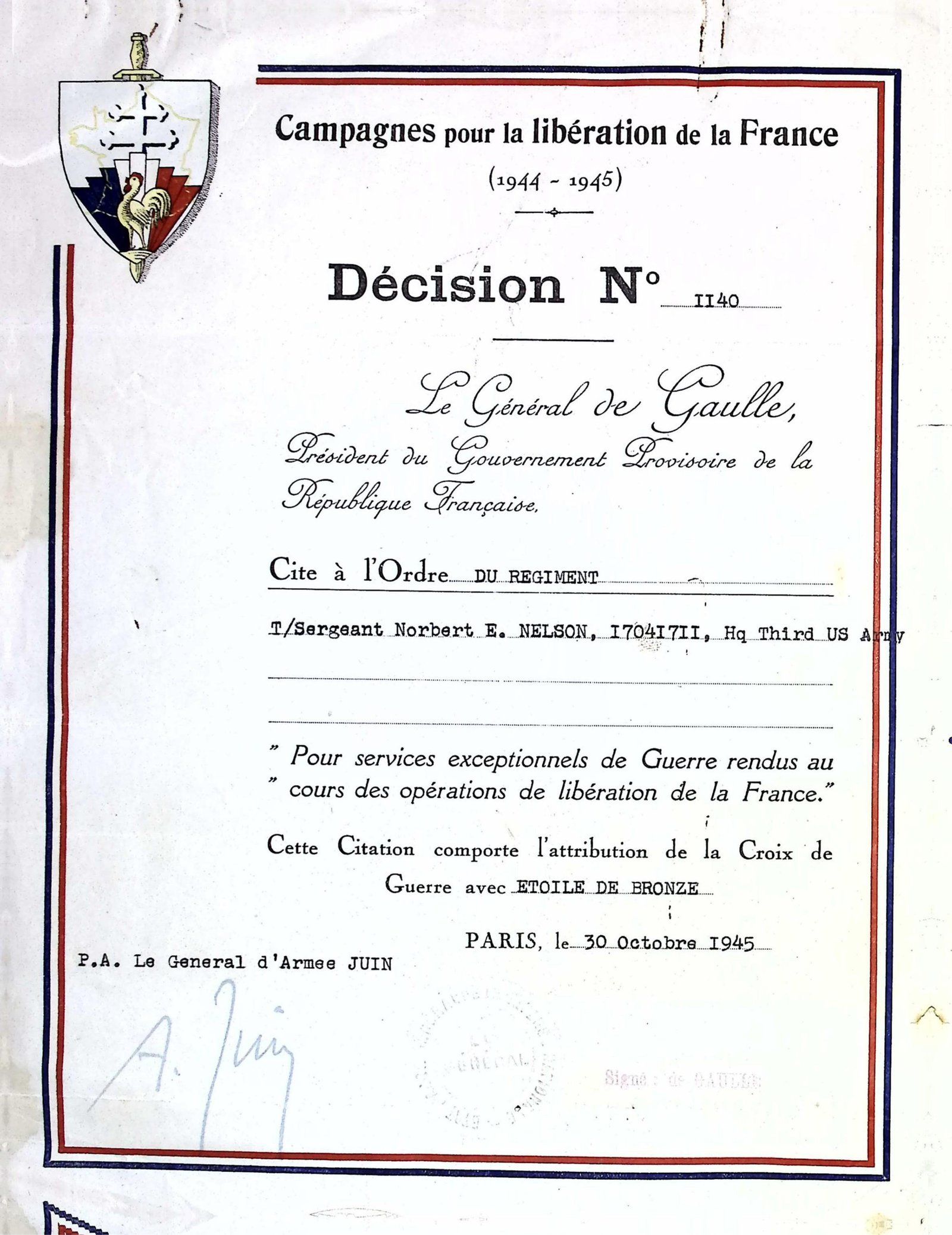
Décision No. 1140, signed by Général de Gaulle and countersigned by Général Juin, Paris, October 30, 1945. Cited “a l'Ordre du Régiment” for exceptional war service during the operations for the liberation of France. Formally transmitted by Headquarters, U.S. Forces European Theater, April 15, 1946.
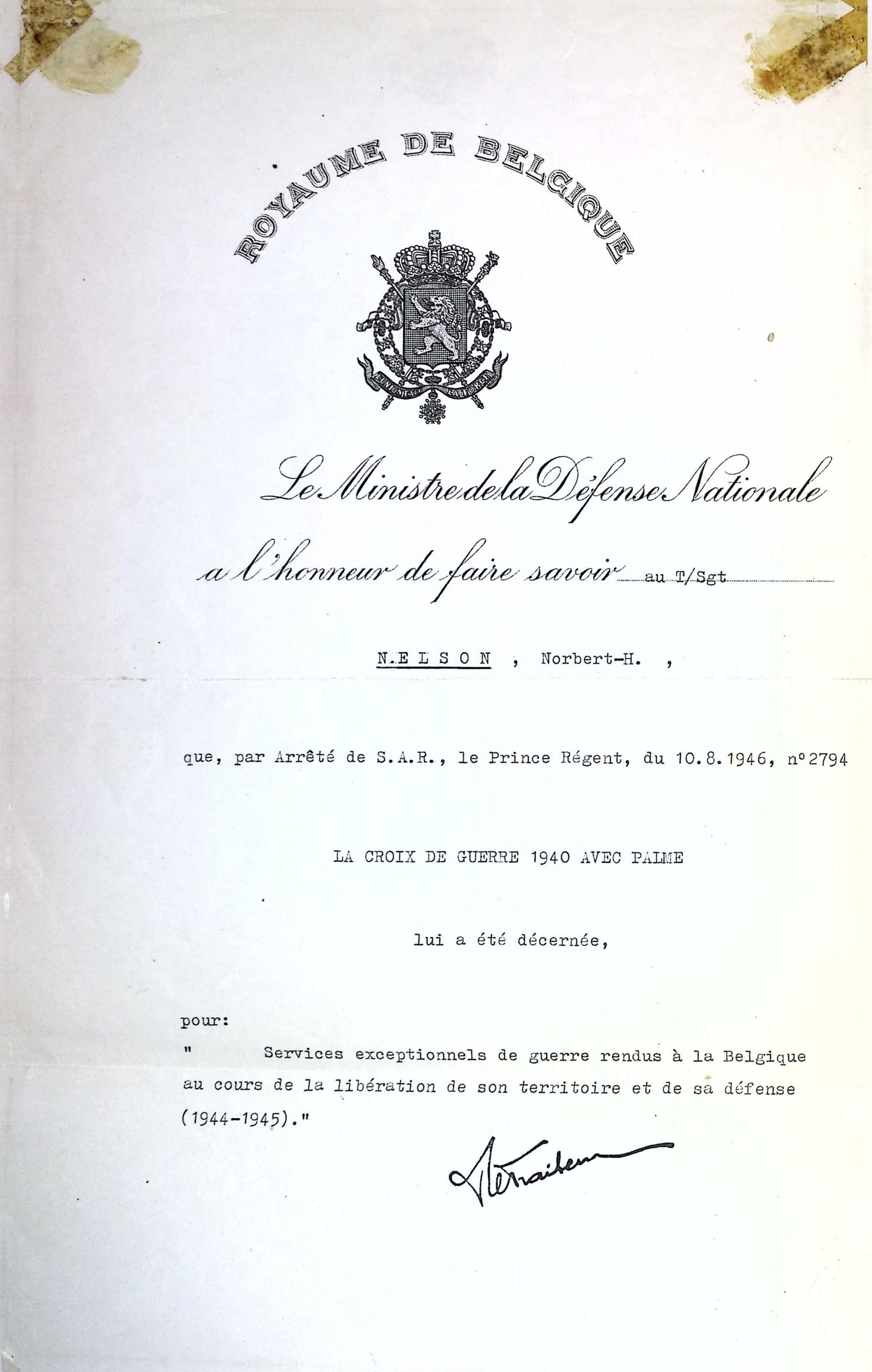
Decree of the Belgian Prince Regent, August 10, 1946, No. 2794, for exceptional war service to Belgium during the defense and liberation of her territory, 1944–1945. The medal and diploma were not actually delivered to him until February 7, 1949 — nearly three years after the decree.
Campaign credit for Normandy, Northern France, Ardennes (Battle of the Bulge), Rhineland, and Central Europe.
1945
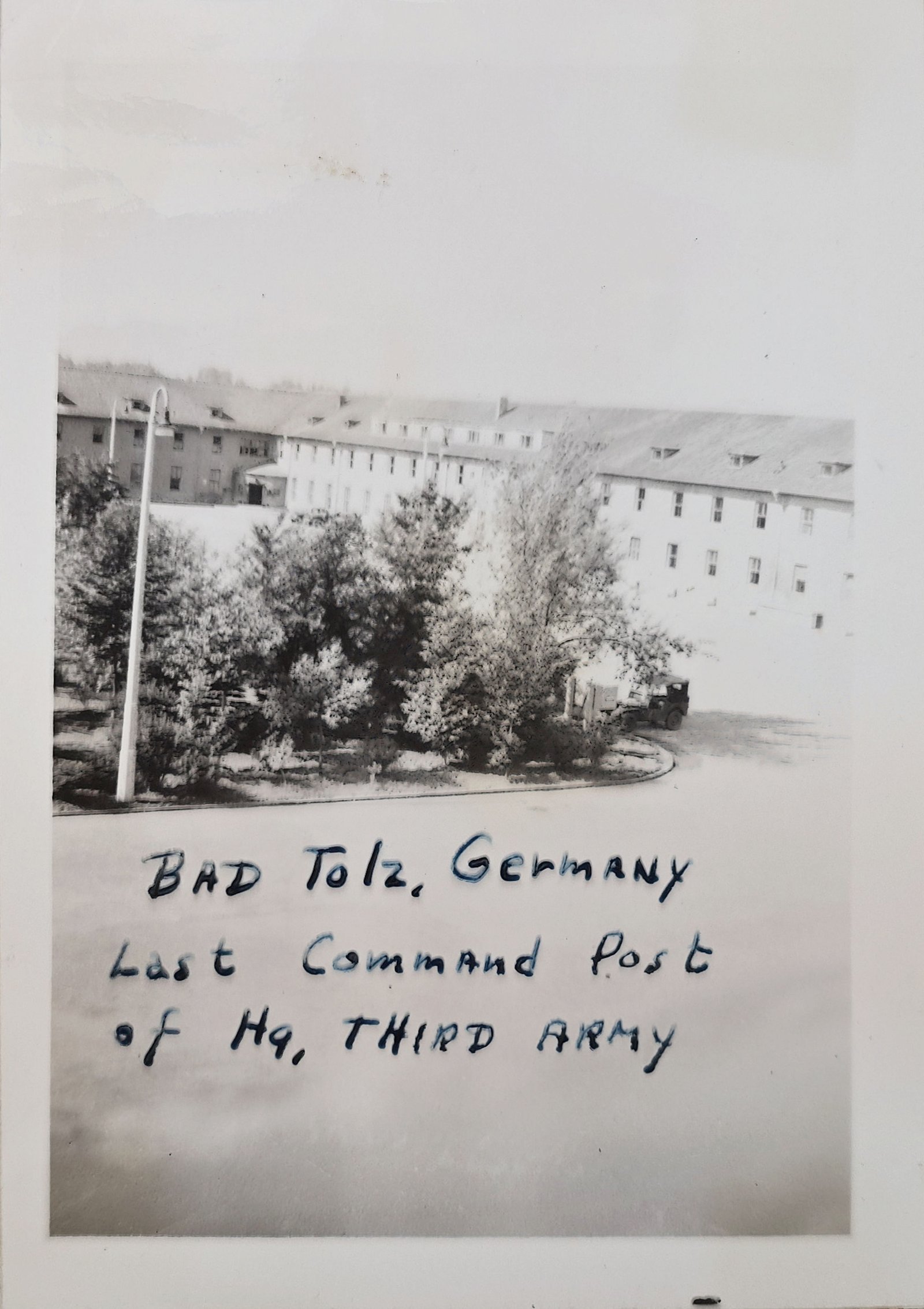
Third Army's fighting war ended May 7, 1945, at Regensburg — Norbert's own letter home, written that same week, called it plainly: 281 days after Utah Beach, and the guns had finally stopped. He moved with Headquarters to Bad Tölz, Germany, its last command post, then on to occupation duty in Berlin that August, where he wrote his father about the wreckage of the city and the hunger of a defeated population, and about waiting — like every soldier with enough “points” and not enough of them yet — for the ship home.
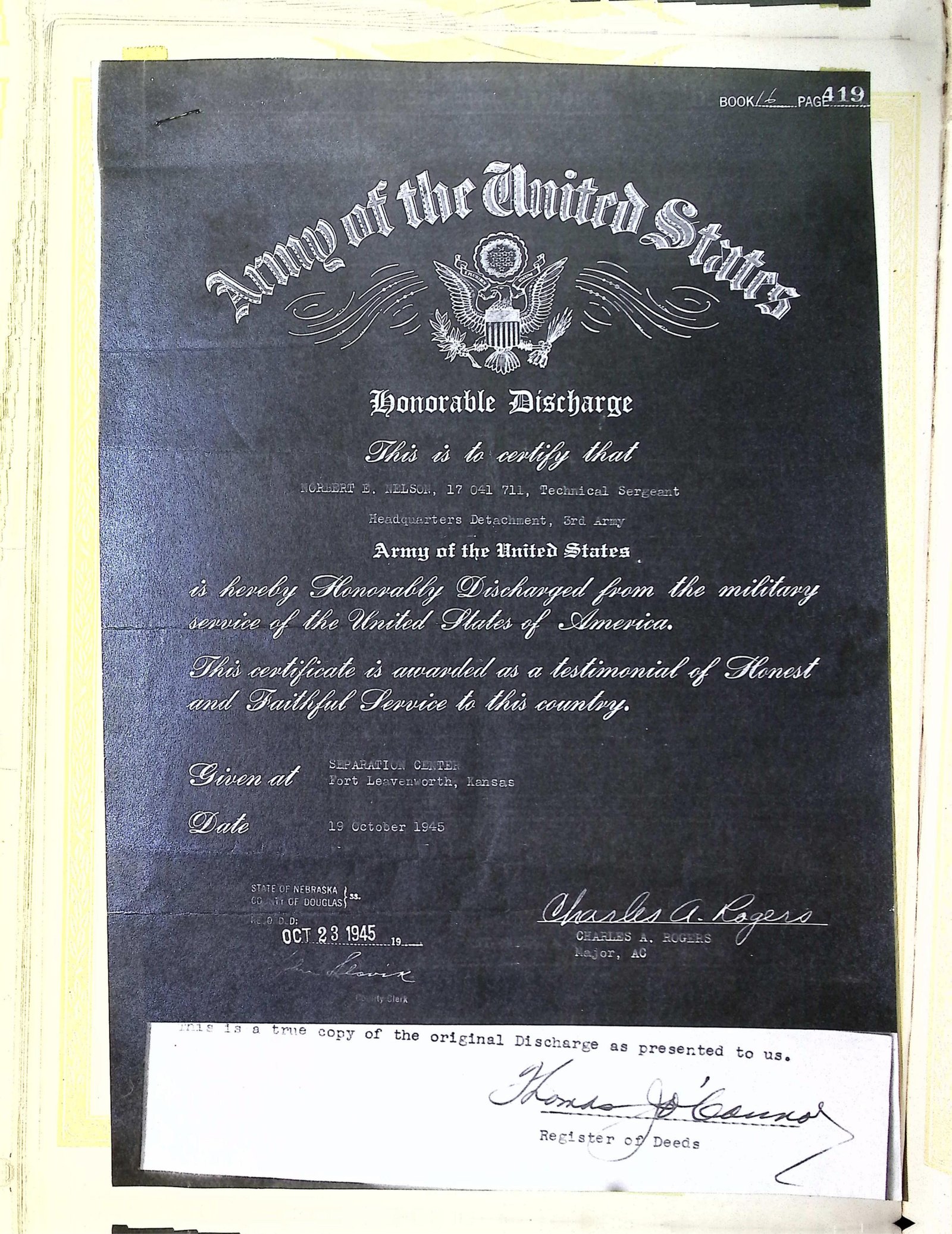
He was discharged October 19, 1945, at Fort Leavenworth, Kansas, a Technical Sergeant of Headquarters Detachment, Third Army, after 41 months of service. He went back to work at Woodmen of the World that November.
After the War
Norbert married Ruth Johnson of Sioux City, Iowa, and settled in Omaha, Nebraska. Their first son, Paul, lived seven days. Their second son, Mark E. Nelson, born 1954, built his own career in public service with the U.S. Army Corps of Engineers — and, in a quiet echo of his father's own wartime role of keeping records straight and information moving, is a named inventor on U.S. Patent 5,283,569, a “Float Actuated Flood Warning System with Remote Telephone Reporting,” assigned to the Army Corps of Engineers, granted in 1994: a low-cost flood warning system built for smaller communities that couldn't otherwise afford one. Norbert, Ruth and Mark lived in North Omaha until 1968, in which year they moved out to the growing suburb of Millard, Nebraska. Norbert and Ruth remained in Millard for the rest of their lives.
Norbert died July 6, 1999, in Omaha. He was buried in Forest Lawn Cemetery. That November, on Veterans Day, a neighbor's quiet project of paper conservation brought one of his own wartime letters — and the memory of what he did with Third Army — back into the local news, and back to Ruth, one more time.
Sources & Documents
Norbert's official military personnel file was lost, along with millions of others, in the 1973 fire at the National Personnel Records Center in St. Louis — confirmed directly with NARA. In its place, this site relies on the materials the family kept: his “His Service Record” scrapbook, his letters home to his father Jonas, his award documents and General Orders, and a handful of official Third Army operational histories, cross-checked against the published historical record of the Third Army's campaigns.